Roulette Rules
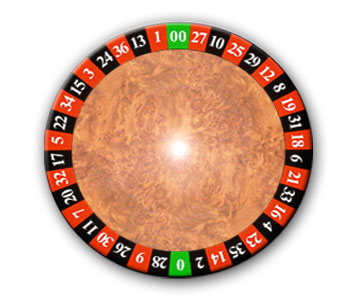
The roulette rules we explain here, are mostly valid for both, European Roulette and American Roulette. Especially the payout ratios are identical. The major differences between both are in the winning probabilities, since the wheel for American roulette also has a "double zero", and thus has 38 slots instead of 37. Therefore, the European roulette is the American always preferable. All calculations in the examples and articles devoted to the roulette rules, are derived from the European Roulette. You will find a summary for each roulette rule in this article. In addition to every single rule there is one further, separate article.
Payout ratios - winning chances - roulette probabilities
- Details
- Created on Saturday, 23 July 2011 16:59
- Last Updated on Thursday, 27 October 2011 18:44
The winning probability is the value, which can be calculated with the help of probability theory and set theory. Mostly are percentage values most meaningful here. A probability of 100 percent means a safe arrival of an event and a value of 0 percent means a safe lack of an event.
The payout ratio describes the relationship between the stake and payouts in case of winning. The terms of odds and payout ratio are used synonymously. In roulette, the payout ratio increases proportionally with decreasing probability. In other words this means that the lower the probability, the higher the payout.
Read more: Payout ratios - winning chances - roulette probabilities
Roulette rules - Plein - Straight Up
- Details
- Created on Saturday, 23 July 2011 18:07
- Last Updated on Thursday, 27 October 2011 21:13
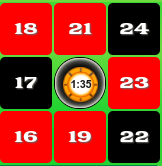
Playing on Plein (also known as Straigth Up) is a bet on a single number. If the number actually appears is that a reason for joy, because the bet stake is multiplied with 35 and will be paid out in addition to the original bet stake itself. If somebody hits a Plein three times in a row, it is also called, the defeat of the rules of roulette.
| Name | Payout ratio | Probability | Bet example |
|---|---|---|---|
Plein / Straight Up |
1 : 35 | 1 : 37 | ![]() |
Roulette rules - Cheval - Split Bet
- Details
- Created on Saturday, 23 July 2011 19:07
- Last Updated on Thursday, 27 October 2011 19:00
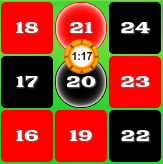
Playing on Cheval is a bet on two adjacent numbers. When the ball hits one of the two numbers, the bet stake will be multiplied by 17 and paid out in addition to the original bet stake. The roulette rules for Cheval are the same worldwide. This also holds true for most other rules in roulette.
| Name | Payout ratio | Probability | Bet example |
|---|---|---|---|
Cheval / Split Bet |
1 : 17 | 2 : 37 |
![]() |
Roulette rules - Transversale Plein - Street Bet
- Details
- Created on Saturday, 23 July 2011 19:18
- Last Updated on Thursday, 27 October 2011 19:01
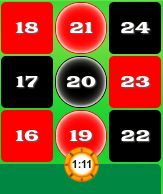
The Transversale Plein (also known as Street Bet) is a bet on three adjacent numbers, which are generally vertically adjacent to each other. There are two exceptions where the numbers are not vertical adjacent to each other. In the event of a win, the bet stake is multiplied by a factor of 11 and paid out in addition to the original bet stake.
| Name | Odd | Probability | Bet example |
|---|---|---|---|
Transversale Plein / Street Bet |
1 : 11 | 3 : 37 |
![]() |
Roulette rules - Carre / Corner Bet
- Details
- Created on Saturday, 23 July 2011 19:28
- Last Updated on Thursday, 27 October 2011 19:01
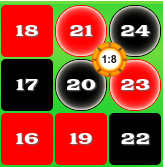
In this chapter we deal with the roulette rules for the Carre (also known as Corner Bet). This is a bet on four numbers, which are located in a square of 2 by 2 numbers. The bet stake will be placed on the center cross of the 4 numbers. In the event of a win, the bet stake is multiplied with 8 and is paid out in addition to the original bet stake.
| Name | Payout ratio | Probability | Bet example |
|---|---|---|---|
Carre / Corner Bet |
1 : 8 | 4 : 37 |
![]() |
Roulette rules - Transversale Simple - Six Line - Double Street
- Details
- Created on Saturday, 23 July 2011 19:32
- Last Updated on Thursday, 27 October 2011 19:03
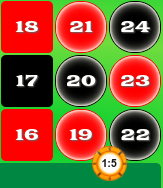
A bet on a Transversale Simple (also called Six Line or Double Street bet) covers 6 numbers. Here the stakes at the lower or upper end of the playing field between two vertical rows of 3 numbers to be placed. If one of the six numbers is hit, the player gets paid in addition to the original bet, the 5 times of his bet.
| Name | Payout ratio | Probability | Bet example |
|---|---|---|---|
Transversale Simple / Six Line / Double Street |
1 : 5 | 6 : 37 |
![]() |
Read more: Roulette rules - Transversale Simple - Six Line - Double Street
Roulette rules - Dozens, Columns
- Details
- Created on Saturday, 23 July 2011 19:35
- Last Updated on Thursday, 27 October 2011 19:04
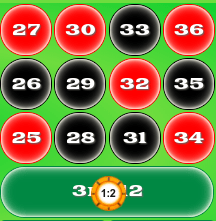
The game on Dozens or Columns is a bet on 12 numbers. This bet is also known as three times game. In case of winning, the player gets the original bet stake back and additionally twice the bet stake.
| Name | Payout ratio | Probability | Bet example |
|---|---|---|---|
Dozens, Columns |
1 : 2 | 12 : 37 |
![]() |
Roulette rules - Zero
- Details
- Created on Friday, 02 September 2011 15:06
- Last Updated on Thursday, 27 October 2011 19:04
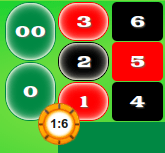
Zero is the number of bank, but you can bet on Zero like on any other number. If Zero is played as Plein, it behaves like a regular number on the roulette table. All other bets - except for the Simple Chances - lose if Zero appears.
Roulette rules - Simple Chances
- Details
- Created on Wednesday, 26 October 2011 14:54
- Last Updated on Wednesday, 26 October 2011 15:40
Equally popular and controversial are the Simple Chances at roulette. The Simple Chances are all bets on colors (Red or Black), all bets on Even or Odd, and all bets on Manque (small numbers 1-18) or Passe (large numbers 19-36).
All Simple Chances are a subset of 18 numbers, representing a winning percentage of 48.65%.
In the case of winning the stake multiplied by factor 1 plus the original stake is paid back to the player. Especially popular for Simple Chances are strategies like Martingale and Paroli.
On any Simple Chances at roulette the same rules are applied. These rules can vary depending on the casino. There are two different versions of roulette rules for Simple Chances. The differences come to bear only when zero falls. In the first rule variation all bets on Simple Chances become halfed, if Zero falls. After the halving the stakes will paid back to the player. In the second rule variant, all bets located on the Simple Chances (at the time of the appearance of zero) become blocked for the next round. If then in the next round the blocked stake will win, then the stake is free again and will paid back to the player without deduction but also without additional payout ratio. If you are in doubt, how the roulette rules for Simple Chances behave, ask directly at the roulette table.
American Roulette
- Details
- Created on Tuesday, 06 September 2011 12:19
- Last Updated on Thursday, 27 October 2011 18:27
The rules for American Roulette differs from European Roulette rules mainly by the so-called Double Zero, by the arrangement of the numbers on the wheel and the rules for Simple Chances. Generally you should stay away from the American Roulette. The article explains why.
The Tronc
- Details
- Created on Thursday, 27 October 2011 16:02
- Last Updated on Thursday, 27 October 2011 21:55
The Tronc is the tip container for the employees of the casino.
Roulettiquette
- Details
- Created on Thursday, 27 October 2011 17:04
- Last Updated on Thursday, 27 October 2011 21:15
The Roulettiquette refers to the common rules of etiquette, or general rules of behavior when a guest visits a casino where roulette is played. The Roulettiquette starts with the style of the clothes and stops with tip for the Croupiers.
Roulette Croupier - Roulette Dealer
- Details
- Created on Thursday, 27 October 2011 21:44
- Last Updated on Thursday, 27 October 2011 21:58
The Croupier is a casino employee and responsible for the rule conform execution of the game at the roulette table. He observes the compliance with the rules of roulette.