Roulette is one of those games that looks complicated from across the room but clicks within a few spins. A ball goes around a spinning wheel, lands on a number, and anyone who bet on that number (or its colour, or its range) gets paid. That’s really the whole thing.
Roulette has been pulling people to casino tables for two centuries. The reason is the gap between how easy it is to start and how much depth opens up once you settle in, a first-timer can sit down and play within thirty seconds, and an old hand still finds new combinations to try.
The Wheel and the Table
There are three main types of roulette games – European, French, and American. All of them share similar layouts, but each variant has unique features.
European and French wheels both run 37 pockets, 1 to 36 in alternating red and black, plus one green zero. American wheels add a second green pocket marked 00, so 38 in total. That single extra pocket is the only structural difference between European and American, but it nearly doubles the house edge. When the choice is yours, European wins on the maths every time.
French roulette has a unique rule called La Partage. If you bet on an outside (even-money) bet and the ball lands on zero, you get a 50% refund on your wager. That gives French roulette the highest theoretical RTP of the three variants:
- French roulette – 98.65% RTP (with La Partage)
- European roulette – 97.30% RTP
- American roulette – 94.74% RTP
The table layout is where you place your bets. Numbers are arranged in a grid of three columns and twelve rows. Around the edges you’ll find spots for broader bets like red/black, odd/even, and high/low. Each position on the table corresponds to a specific bet with its own payout.
The layout looks busier than it actually is. Spend two minutes finding where each bet type lives. Inside bets on the numbered grid, outside bets in the labelled bands wrapping around it. The rest falls into place.
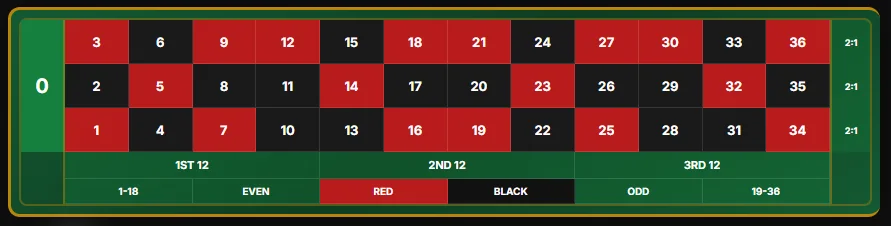
Understanding the Bets
Bets split into two groups based on where they go on the felt: inside bets sit on the numbered grid, outside bets sit on the wider sections around it. The split also tells you the risk profile. Inside bets pay big when they land but land rarely. Outside bets pay less but land far more often.
Inside Bets (higher risk, higher reward)
These bets cover individual numbers or small groups. They don’t hit very often, but when they do, the payouts are substantial. Most experienced players mix inside bets with outside bets to balance risk and reward.
- Straight Up – Bet on a single number. Pays 35 to 1. The longest shot on the table, but landing one feels incredible.
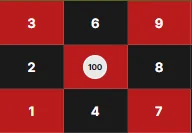
- Split – Bet on two adjacent numbers by placing your chip on the line between them. Pays 17 to 1.
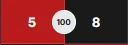
- Street – A row of three numbers. Place your chip on the outer edge of the row. Pays 11 to 1.
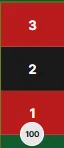
- Corner – Four numbers that share a corner on the grid. Place your chip at the intersection. Pays 8 to 1.
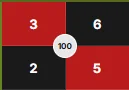
- Six Line – Two adjacent rows, covering six numbers. Place your chip on the outer corner where the two rows meet. Pays 5 to 1.
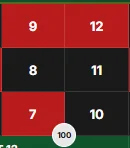
Outside Bets (lower risk, steadier returns)
These bets sweep big chunks of the table at once. The even-money options, red/black, odd/even, high/low, clear nearly half the wheel each, so wins arrive often even if each one is small. That steady cadence is why most beginners start here, and why almost every documented betting system runs on outside bets.
- Red / Black – Bet on the colour. Wins just under half the time (48.65%). Pays 1 to 1. The reason it’s not quite 50/50 is the zero pocket, which is green — it loses for both red and black.
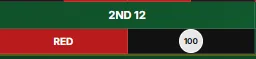
- Odd / Even – Bet on whether the number is odd or even. Same odds as red/black. Zero counts as neither.
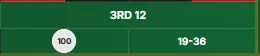
- High / Low – 1-18 (low) or 19-36 (high). Same payout and probability as the other even-money bets.

- Dozens – First 12 (1–12), second 12 (13–24), or third 12 (25–36). Pays 2 to 1. Covers a third of the numbers.
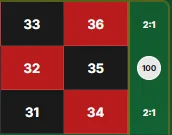
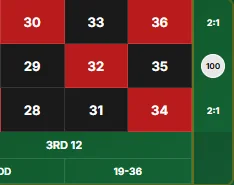
- Columns – One of three vertical columns on the grid. Pays 2 to 1. Each column has a three-number gap: the first column is 1, 4, 7, 10, 13, 16, 19, 22, 25, 28, 31, 34; the second is 2, 5, 8, 11, 14, 17, 20, 23, 26, 29, 32, 35; the third is 3, 6, 9, 12, 15, 18, 21, 24, 27, 30, 33, 36.
How a Round Works
Every round runs through the same four beats. Two or three rounds in, you stop thinking about them.
Online vs In-Person Roulette
The online version and the version on a casino floor share the same rulebook. What changes is everything around the rules, pace, bet placement, how you put money in and out, and how the wheel itself works. The points below are the gaps worth knowing before you sit down at either format:
- Game fairness. Online roulette at licensed casinos is regulated by certified random number generators (RNGs) or provably fair systems that guarantee unbiased outcomes. In-person games rely on the physical wheel and the trained dealer. Both approaches are fair when they’re properly regulated.
- Deposits and cash-outs. At a physical casino you exchange cash for chips at the table or cage. Online casinos accept a mix of bank cards, e-wallets, prepaid cards, and cryptocurrencies, but not cash. Our simulator doesn’t require any deposit at all — every account gets free daily coins.
- Accessibility. In-person roulette requires travelling to a venue that has it. Online roulette runs on any device with a browser, which is why it’s grown so much faster. Some jurisdictions restrict online play, so check your local rules before signing up on a real-money site.
- Pace of play. Online rounds usually finish in 20–40 seconds because there’s no chip placement by the dealer. In-person rounds take closer to 60–90 seconds. That makes online better for learning and practice, since you can run through far more hands per hour.
Tips for Beginners
If you’re brand new to roulette, these tips will help you get started without making the common beginner mistakes:
- Start with outside bets. Red/black, odd/even, and high/low give you nearly a 50/50 chance of winning. They’re the easiest way to learn the rhythm of the game without burning through your coins.
- Play European, not American. The house edge is 2.70% vs 5.26%. Over a session of 100 spins, that difference is real money (or in our case, real coins). There’s no benefit to playing American roulette if European is available.
- Set a budget before you start. Decide how many coins you want to play with this session, and stop when you hit that number. This is the most important habit in roulette, regardless of skill level.
- Don’t chase losses. If you lose five spins in a row, the temptation is to bet bigger to win it back. Resist it. Every spin is independent, and increasing your bets while losing is the fastest way to empty your bankroll.
- Mix bet types. Once you’re comfortable, try combining an outside bet (like red) with one or two straight-up numbers. This gives you the safety of frequent small wins with the chance of hitting a big payout.
- Use the rebet button. If you found a combination you like, there’s no need to place every chip again manually. The rebet feature copies your previous round’s bets in one click.
- Remember that zero is green. Zero loses for red, black, odd, and even. It’s the pocket that creates the house edge, and beginners sometimes forget about it. On a European wheel, it hits about once every 37 spins.
Common Misconceptions
Roulette has been around long enough that several myths have become widely believed. Here are the ones you’ll hear most often, and why they’re wrong:
- "Red is due after a long run of black." This is called the gambler’s fallacy. The wheel has no memory. Each spin is completely independent. After 10 blacks in a row, the odds of the next spin being red are still 48.65%, exactly the same as any other spin.
- "Dealers can influence where the ball lands." In a physical casino, this would require superhuman precision. In our simulator, results are generated using a cryptographically secure random number generator. Neither can be manipulated.
- "Betting systems guarantee profit." No betting system can overcome the house edge mathematically. Systems like Martingale can increase your short-term win rate, but they do so by taking on the risk of larger losses. Over thousands of spins, the house edge wins out.
- "Some numbers are luckier than others." On a fair wheel (physical or virtual), every number has exactly the same probability of hitting. Number 17 isn’t luckier than number 3. James Bond’s preference for 17 is fiction.
How Our Simulator Works
The simulator behaves the way a regulated online table would. Every spin is decided server-side by a CSPRNG, the cryptographically secure RNG that licensed casinos run under audit, before the wheel animation even starts moving. Nothing on your end can tilt the result, and nothing in the animation gives a clue. It's fair the same way the real game is fair.
An account picks up 1,000,000 coins per day, no questions asked. There's no payment step anywhere, no deposit, no card, no real cash on the line. The point is to give you a place to learn the game properly, run strategies long enough to see how they actually behave, and have a good time doing it.
We offer solo tables (play at your own pace), multiplayer tables (play alongside other players in real time), and tournaments (compete for the top of the leaderboard). All three game modes follow standard European or American roulette rules.
Try It Yourself
The fastest way to learn roulette is to play a few rounds. Reading about bet types is useful, but actually watching the wheel spin and seeing how different bets pay out makes everything click much faster. Create a free account, claim your daily coins from the Store, and start playing.