Every roulette bet has a fixed payout ratio. The higher the payout, the less likely you are to win it. Simple as that. But understanding exactly how the numbers break down helps you make smarter choices about where to put your chips.
The key thing to know is that the payout ratios are the same on both European and American wheels, but the probabilities are different because American roulette has an extra pocket (the double zero). This means American roulette gives you slightly worse odds on every single bet, even though the payouts look identical.
Roulette Payout Chart
Quick reference for every roulette bet, payout ratio, and probability:
| Bet Type | Payout | European Odds | American Odds |
|---|---|---|---|
| Straight Up | 35:1 | 2.70% | 2.63% |
| Split | 17:1 | 5.41% | 5.26% |
| Street | 11:1 | 8.11% | 7.89% |
| Corner | 8:1 | 10.81% | 10.53% |
| Six Line | 5:1 | 16.22% | 15.79% |
| Red / Black | 1:1 | 48.65% | 47.37% |
| Odd / Even | 1:1 | 48.65% | 47.37% |
| Low / High | 1:1 | 48.65% | 47.37% |
| Dozens | 2:1 | 32.43% | 31.58% |
| Columns | 2:1 | 32.43% | 31.58% |
The House Edge
The house edge is the casino’s built-in advantage on every bet. It represents the percentage of each wager that the casino expects to keep over the long run. Here’s how the three roulette variants compare:
RTP stands for "return to player." A 97.30% RTP means that for every 100 coins wagered over time, you can expect to get back 97.30 on average. The remaining 2.70 is what the house keeps.
One important caveat: this doesn’t mean you’ll receive 97.30 coins back for every single 100 coins you wager. RTP is a long-run statistical average, measured over millions of rounds. In any individual session — 20 spins, 100 spins, even 1,000 spins — your actual results can vary widely from the theoretical figure. The RTP only shows its true shape over very long samples.
Where Does the House Edge Come From?
On a European wheel there are 37 pockets (numbers 0 through 36). A straight-up bet on a single number pays 35 to 1, which is the correct payout if there were only 36 pockets. That 37th pocket (the zero) is where the house edge lives. Every bet on the table is calculated as if zero didn’t exist, but it does.
American roulette adds a second zero (00), making 38 pockets total. The payouts still act as if there are 36 pockets. Two extra pockets means roughly twice the house edge.
This is why the house edge is identical for every bet on the table (with one exception on American roulette: the basket bet at 7.89%). It’s not that some bets are "better" than others in terms of expected value. They all give the house the same percentage edge. The difference is just in risk profile: how often you win and how much you get when you do.
Inside Bets: Payouts and Odds
| Bet Type | Description | Payout | European Odds | American Odds | |
|---|---|---|---|---|---|
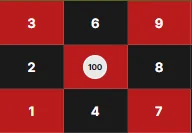 | Straight Up | Single number | 35:1 | 2.70% | 2.63% |
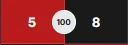 | Split | Two adjacent numbers | 17:1 | 5.41% | 5.26% |
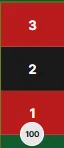 | Street | Row of three | 11:1 | 8.11% | 7.89% |
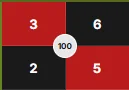 | Corner | Four numbers | 8:1 | 10.81% | 10.53% |
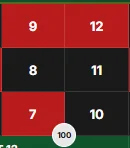 | Six Line | Two rows (six numbers) | 5:1 | 16.22% | 15.79% |
Inside bets are the ones placed on specific numbers or small groups of numbers within the main grid. They win less often but pay significantly more when they hit. A straight-up bet landing gives you 35 times your stake back, which is why it remains the most exciting bet on the table despite only hitting once every 37 spins on average.
Outside Bets: Payouts and Odds
| Bet Type | Description | Payout | European Odds | American Odds | |
|---|---|---|---|---|---|
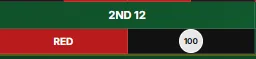 | Red / Black | Color of winning number | 1:1 | 48.65% | 47.37% |
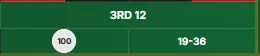 | Odd / Even | Odd or even number | 1:1 | 48.65% | 47.37% |
 | Low / High | 1-18 or 19-36 | 1:1 | 48.65% | 47.37% |
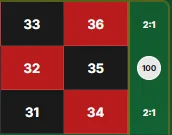 | Dozens | Group of 12 | 2:1 | 32.43% | 31.58% |
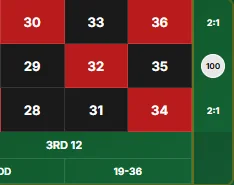 | Columns | Vertical column | 2:1 | 32.43% | 31.58% |
Outside bets cover broader groups and hit much more frequently. A bet on red or black wins nearly half the time. The trade-off is that the payout is only 1:1, so you’re essentially trying to grind out small profits rather than swinging for a big win. Most beginners start with outside bets because the frequent wins keep things interesting.
How to Calculate Roulette Odds
Calculating the probability of winning any roulette bet is straightforward. Take the number of winning outcomes and divide by the total number of pockets on the wheel.
Win Probability Formula
P(win) = numbers covered / total pockets
Example: Red on European wheel
18 red numbers / 37 total pockets = 48.65%
Example: Red on American wheel
18 red numbers / 38 total pockets = 47.37%
The expected value of any bet can be calculated too. Multiply the payout by the probability of winning, then subtract the probability of losing. For a 10 unit bet on red in European roulette:
(10 × 1 × 18/37) - (10 × 19/37) = 4.865 - 5.135 = -0.27 per spin on average. That’s the house edge in action: about 2.7% of your bet.
European vs American: The Numbers
The table below puts the difference in sharp focus. Same bets, same payouts, worse odds on the American wheel across the board:
| BET | EUROPEAN | AMERICAN | DIFFERENCE |
|---|---|---|---|
| Red/Black | 48.65% | 47.37% | -1.28% |
| Single Number | 2.70% | 2.63% | -0.07% |
| Dozens | 32.43% | 31.58% | -0.85% |
| House Edge | 2.70% | 5.26% | +2.56% |
| Expected Loss per 100 | 2.70 | 5.26 | +2.56 |
Over 100 spins at 10 units per bet, the expected difference between European and American is about 25.6 units. Over 1,000 spins, it’s 256 units. The longer you play, the more that gap costs you. Play European whenever you have the option.
The French Roulette Advantage
French roulette with La Partage or En Prison rules offers the best odds at any roulette table. When the ball lands on zero, even-money bets lose only half (La Partage) or get a second chance (En Prison). Both rules cut the house edge on even-money bets from 2.70% to just 1.35%.
To put that in perspective, French roulette’s 1.35% edge is better than most slot machines, better than craps’ pass line (1.41%), and comparable to blackjack played with basic strategy. If you’re looking for the best mathematical return at the roulette table, even-money bets on a French wheel are it.
The catch is that the 1.35% edge only applies to even-money bets (red/black, odd/even, high/low). Inside bets still carry the standard 2.70% edge even on French tables.
Practical Odds Tips
- Every spin is independent. The ball has no memory. If red has hit 10 times in a row, the odds of the next spin being red are still 48.65%. The "gambler’s fallacy" is the single most common mistake in roulette.
- No bet combination changes the house edge. Spreading chips across multiple bets doesn’t improve your expected return. It changes the volatility of your session, not the maths.
- Payouts are designed so the house always wins long term. A straight-up bet pays 35:1, but the true odds are 36:1 (European) or 37:1 (American). That gap is the house edge.
- Short sessions are more unpredictable. In 20 spins, anything can happen. Over 20,000 spins, results will converge toward the mathematical expectation. This is why casinos are profitable and individual sessions feel random.
- Use a simulator to see the maths in action. Playing hundreds of spins on our free simulator will give you a visceral understanding of probability that no article can match.